What if planetariums can project 1 million stars? What if such planetariums can be transported freely? I came here to present an answer to these dreams.
|
| IPS presentation in London! |
| The 14th International Planetarium Society(IPS) conference
was held in London in June 1998. I presented my handmade high performance
planetarium projector "MEGASTAR" at the occasion. Moreover, I brought the
projector into a special inflatable dome placed on the conference place.
The MEGASTAR's sky in the dome has fascinated spectator with it's quality, sharpness and reality. My presentation succeed and was very good received thank you! I am publishing the full document of my presentation which was published at the conference. Note: I called my latest projector "ASTROLINER-2" at the conference. But It was renamed "MEGASTAR". |
What if planetariums can project 1 million stars? What if such planetariums can be transported freely? I came here to present an answer to these dreams.
|
| I am Takayuki Ohira a Japanese planetarium
developer. I would like to present my unique mobile planetarium projector.
First, allow me to introduce myself and my planetarium history.
I have been building planetarium projectors since I was a boy. One of them, this model-2 projector was completed in my highschool days. It is a double-ball type planetarium with my unique lithograph film star projectors. After model-2 was completed, I went on to college and tried to build a larger planetarium. I bumped into many technical and non-technical problems. And I have developed several technologies to solve these problems. 4 years went past. I at last completed the model-3 projector and named it "ASTROLINER". This was Nov, 1991 |
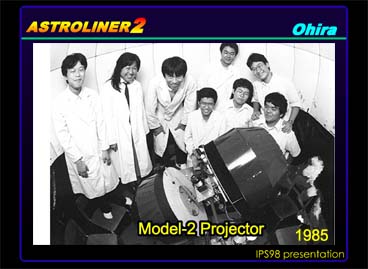
Former projector MODEL-2 |
|
This is my former planetarium model, the ASTROLINER star projector. To the best of my knowledge, this was the then only optical star projector in the world made by an student. It was capable of reproducing about 45, 000 stars using 32 projection optics on 6 to 12-meter domes. The planet, sun and other solar system element projectors were controlled independently by a computer. |
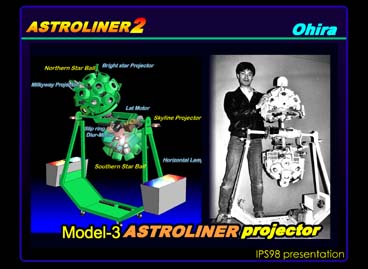
Former projector ASTROLINER |
| This is an inflatable dome for the ASTROLINER projector. It is
10 meters in diameter and, 7 meters high, and capable of accommodating
about 100 people. The dome's body is made of thin shield plastic
film. I believe it is the largest inflatable planetarium dome in the world.
Yes, the ASTROLINER was meant to be mobile. I have displayed it on 11 occasions
in various places. But this projector was not easy to run, because it was
too complicated, too heavy, and too large. This is why, I came up with
the plan to build a new projector. My idea was to build the star projector
so compact and so small that I can transport it alone with my own car.
No doubt the performance must be greater!
2 years went past. Most of the new star projector is completed. |
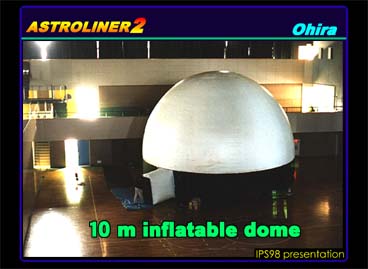
10 meter inflatable dome |
|
This is the ASTROLINER-2 star projector, my latest high-performance mobile planetarium projector. The star sphere appears as a single ball. The star projector weighs 30 kg and is 60 cm high. It can be transported by a single man on a single passenger car. It includes high quality star projection optics, motion mechanism, light sources, electronic circuits, and a computer. The stars are reproduced through 32 projection lenses. It can reproduce over 1 million stars up to magnitude 11. This star projector has a 3-axis rotary mechanism controlled by an internal computer. Each axis is driven by high powered motor. The motors can be rotated at optional speed with a maximum of 2 seconds per rotation. The computer is connected to an external computer. It is capable of reproducing many motions, as the diurnal, latitudinal, precession or any other motions. |
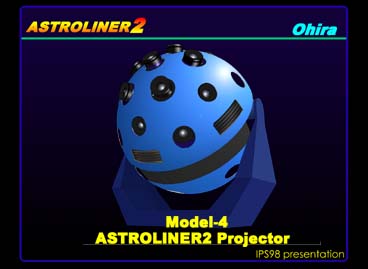
Latest ASTROLINER-2 projector |
|
This graph shows the number of stars along with their magnitude. It outnumbers most planetariums. Now why do we need to reproduce so many fainter stars ? This is because, I want to make the projection as real as the sky. Most planetariums usually reproduce thousands to tens of thousands stars. But I don't think that is enough to reproduce a real sky. For example, the Milky Way consists of so many faint stars. But In many other instruments, the milky-way is reproduced by additional projectors or additional process on the star plates, to show something like a dim cloud. But this is far from real. I believe the best way to produce a real sky is to show fainter stars, just as it is on the real sky. Of course, more than 200 billions stars glitter in our galaxy. I have materialized this idea on my ASTROLINER-2 projector. As a result, I succeeded in reproducing an extremely real sky. |
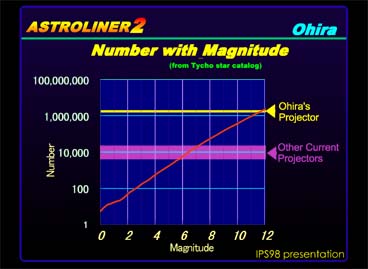
Magnitude table |
| Here, brighter stars constitute constellations. And so many dimmer stars make up the Milky-Way, clusters and other astronomical elements; just like the natural sky! So, how do I reproduce so many faint stars? The secret is my unique star plates. The star images must be extremely small fainter stars. I have developed a super precision star plate with my unique laser lithograph technology. |
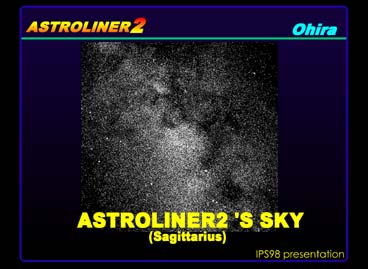
The sky by ASTROLINER-2 |
|
This is my original star plate manufacturing machine. It incorporates the laser head, optics, XY stage and other elements. All functions are controlled by computer. It can automatically open holes as small as 0.5 microns (500 nanometer) in diameter. |
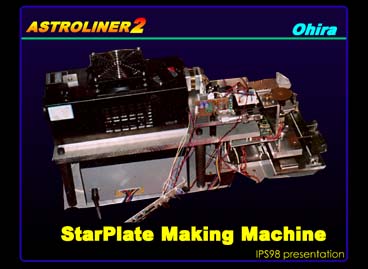
Star plate manufacturing machine |
|
Now allow me to start my demonstration. This is the ASTROLINER-2 star projector. It looks like a single ball. The diameter of this ball is about 45 cm. This can be transported by a single man. Let me show you. As you can see, I am not the mucho type. But I can lift it up easily. Sorry to say, the projector is still not fully completed.
|
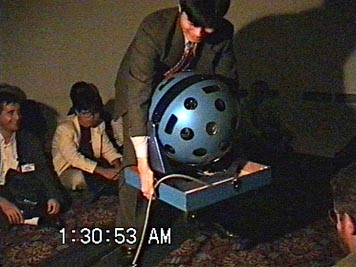
Projection demonstration |
| The projector will be in its full shape by the end of this year.
I also have plans to complete development of new baby planet projectors
and other special projectors. My dream is to present my ASTROLINER-2 all
around the world. I also thinking about the possibility of creating
even smaller star projectors, taking full advantage of my super-precision
star plate technology.
The smaller the star disc on the star plate, the shorter the focal length of the projection lens, making the star projector even more compact. Such miniaturization can open doors to numerous possibilities for mobile planetariums. Thank you for your attention
|
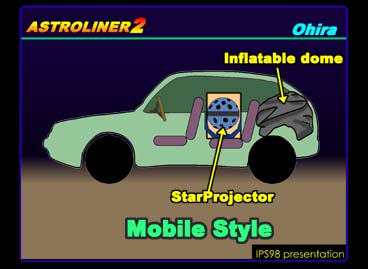
Future plan |